

Fence Post Foam vs. Concrete: What’s Best for Your Fence?
When it comes to installing fence posts, concrete is king.
But despite concrete’s popularity, it’s not the only (or even always the best) option. In recent years, fence post foam has emerged as a compelling alternative to concrete.
But when should you choose fence post foam? Is it appropriate for every fencing project?
In this post, we’ll give you a comprehensive overview of fence post foam vs. concrete. We’ll examine how each product works, its pros and cons, and some common pitfalls to avoid.
If you’re thinking about using fence post foam for your next fencing project, this is the guide for you.
Get a Free Fencing Quote Today
Fence Post Foam vs. Concrete
Let’s begin with a general look at the properties and function of concrete and fence post foam.
Concrete is a mixture of cement, water, an aggregate such as sand or gravel, and other chemicals that enhance the concrete’s performance. It functions as a rigid structural anchor for fence posts, helping to keep out water and secure the post in the ground.
Foam, meanwhile, is made up of a two-part polyurethane resin that expands as it cures. It includes brands such as Sika® PostFix® and Fast 2K™.
Because of how much the foam expands, it’s effective at filling the space between the post and the ground.
However, because of its lightweight properties, it lacks the structural strength of concrete (more on this below).
Ready to dive deeper? Let’s examine the pros and cons of concrete vs. fence post foam.
Why Use Concrete? Pros & Cons
Concrete remains the go-to material for setting fence posts, but is it really the best choice?

Here are some pros and cons to consider:
Pros
Strength
There’s no denying it: concrete is strong.
This strength makes concrete the ideal choice for posts that need to handle heavy loads, such as for decks or gates.
Concrete also holds up well in high winds; the same cannot be said of foam.
Water Management
When properly mixed and poured, concrete will set even in wet soils.
You still need to take some precautions, such as using proper forms and a fast-setting mix like Sakrete.
But due to the way it cures, concrete will naturally displace water present in the surrounding soil. This offers a major advantage over foam when installing fence posts in wet soils.
Cost
Concrete typically costs $5-$8 per bag, depending on the type. This makes it an economical choice compared to foam, which runs $20-$30 per bag.
Durability
While it isn’t completely weatherproof, concrete is known for its durability. It can last 50+ years if properly mixed and poured.
Cons
Labor-Intensive
Mixing and pouring concrete is hard work! A typical bag is heavy, weighing 50 lbs.
And when installing fence posts, you need to dig wider holes than with foam. For a 4”x4” fence post, you’ll need to dig a hole a minimum of 8” wide and 24” deep.
Multiply this by an entire fence, and that’s a lot of back-breaking labor.
Curing Time
Another downside of concrete is the curing time. It takes 24-48 hours to set and another 7-30 days to fully cure.
Wood Rot Risk
While concrete is strong, it’s also naturally porous. This means that, over time, it can wick moisture into wooden fence posts, leading to rot.
You can mitigate potential rot with a fence post sleeve such as Postsaver, but this will increase the cost of your fencing project.
Cracking
Concrete isn’t invincible.
Unless you live in a very warm climate, natural freeze-thaw cycles can crack the concrete over time. This issue is especially pronounced if the soil in your area is high in moisture.
Why Use Foam? Pros & Cons
Compared to concrete, fence post foam offers several advantages. But it also has some significant limitations.
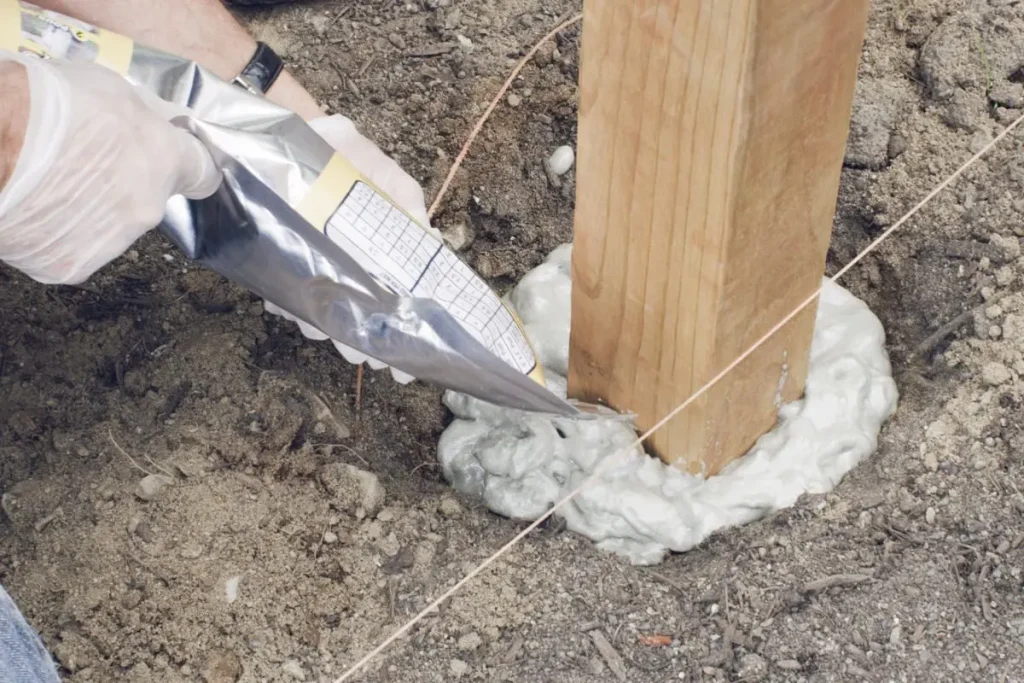
Let’s take a look at both:
Pros
Speed
One of the biggest advantages of fence post foam is speed.
The foam sets within 15 minutes of application. So unlike with concrete, you don’t have to wait days for it to cure.
Ease of Use
Compared to concrete, fence post foam is much easier to work with.
For one thing, it’s lightweight. A typical bag weighs 2.5 lbs (compared to concrete’s 50 lbs).
Fence post foam also mixes directly in the bag, eliminating the need for a separate bucket or concrete mixer.
Water Resistance
Fence post foam can increase the water resistance of the posts.
The foam expands as it cures, which seals gaps between the post and the soil. If the post is set above the water line, this helps reduce wood rot.
Smaller Post Holes
Fence post foam lets you use smaller post holes than concrete (6″ vs. concrete’s 8″ minimum). This reduces labor and saves time.
Cons
Risk of Structural Failure
Fence post foam is strong enough for many fencing applications, but it’s not a good choice for structural projects.
Fence post foam manufacturers specifically warn against using their product for setting deck posts, gate posts, or other structural pieces.
Additionally, fence post foam has the potential to fail in high winds, so bear that in mind if you’re building a fence in an exposed area with high wind potential.
Swamp Incompatibility
In swampy or other high-moisture environments, the groundwater will wash away fence post foam. Reinforced concrete is typically a better choice in these cases.
Repair Issues
Fence post foam will crumble if disturbed, which can be a problem if you need to repair the fence.
Fence post foam is also incompatible with repair spikes. So if the post rots or gets knocked over in a storm, you’ll need to completely remove and replace it.
Cost
The last major con of fence post foam is the price.
On average, it’s 3x more expensive than concrete. This might not matter much for a small project, but it can really add up for a large job.
Want to avoid the hassle of setting posts altogether? Consider driving fence posts instead.
Cost & Time Comparison
We’ve covered a lot of information up to this point.
So here’s a handy cheat sheet you can use when comparing the cost and time involved when using concrete vs. fence post foam:
| Factor | Concrete | Foam |
| Material Cost | $10/post (2 bags) | $30/post (1 bag) |
| Install Time | 60-90 mins/post | 15 mins/post |
| Project Lifespan | 25-50 years | 5-15 years* |
Note that these numbers are approximate; the exact time and cost will vary based on your location, soil properties, and level of experience.
Verdict: Which Material to Use in Different Scenarios?
You should now understand the pros and cons of fence post foam and concrete.
To summarize, here’s a table covering which material is best in different scenarios, along with our reasoning for each:
| Scenario | Best Choice | Why? |
| High water table (common in states such as FL and LA) | Concrete + Steel Posts | Foam washes out; concrete anchors the post in saturated soil. |
| Supporting decks/gates | Concrete | Foam lacks load-bearing capacity. |
| Dry, sandy soil | Foam (if budget allows) | Faster install, adequate for low-wind areas. |
| Repair existing posts | Concrete | Foam is incompatible with repair brackets. |
Need help deciding on the right materials and approach for your next fencing project? The experienced professionals at D&C Fence are standing by to help.